What Is Strategy?
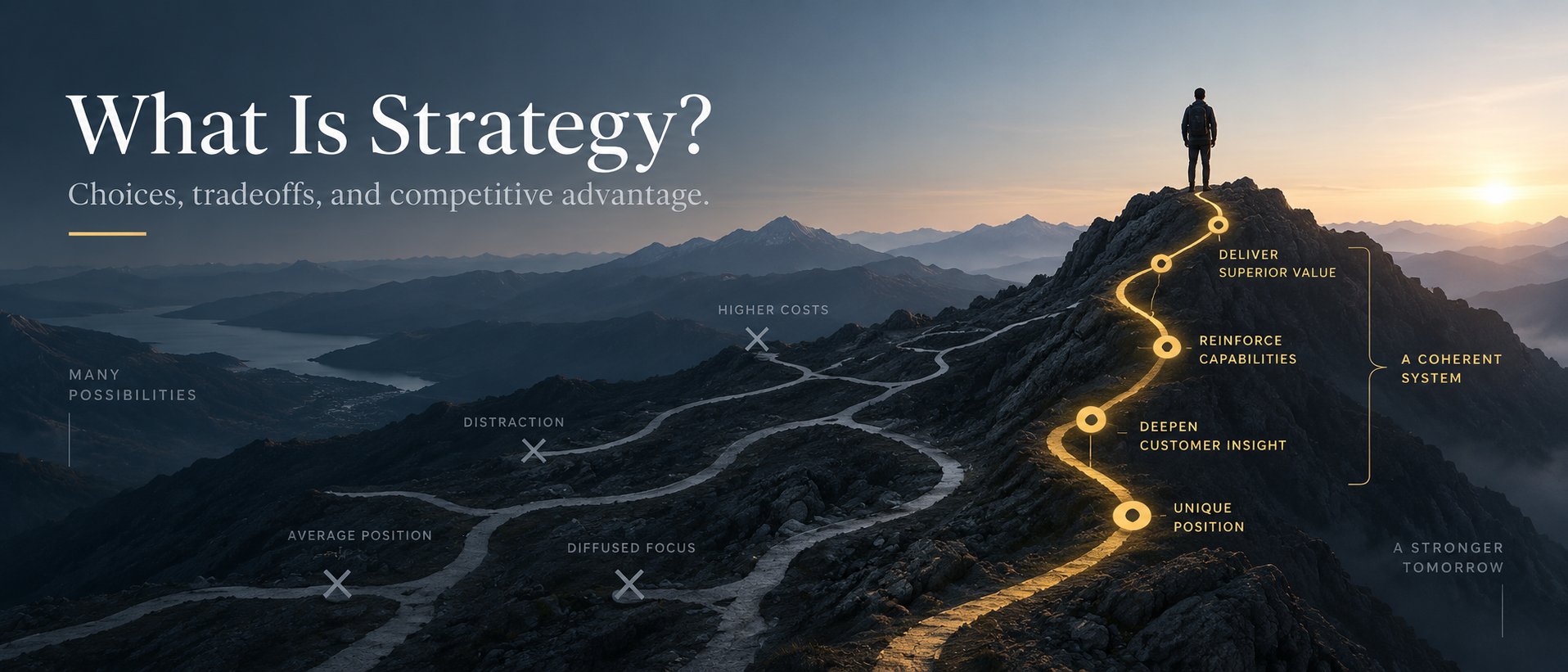
Strategy is about making deliberate choices that create competitive advantage — not setting goals, not listing priorities, not writing mission statements.
The Most Misused Word in Business
Walk into almost any company and ask a senior leader to describe their strategy. You will hear something like this: "We want to be the leading provider of innovative solutions that deliver exceptional value to our customers." That is not a strategy. It is a wish. Nearly every company on earth would sign that sentence without changing a word — which is precisely why it is worthless.
Strategy has a precise meaning, and understanding that meaning changes how you read competitive situations, evaluate business decisions, and diagnose why companies fail. The word gets stretched so far in everyday usage that it loses its analytical power. Getting it right is the first task of any serious business education.
Two phrases in that definition deserve unpacking: integrated set of choices and necessarily involve tradeoffs. Both are doing heavy lifting.
Choices, Not Goals
The most common confusion is mistaking goals for strategy. Goals describe where you want to end up. Strategy describes the logic of how you will get there in a way competitors cannot easily replicate.
"Grow revenue 20% this year" is a goal. "Win the enterprise segment by being the only vendor that integrates with legacy SAP infrastructure" is a strategy. The first tells you nothing about what the company will actually do differently. The second implies a whole chain of choices: what customer problems to solve, what capabilities to build, what partnerships to form, what investments to make, and — crucially — what not to do.
Michael Porter, the Harvard economist who gave strategy its most rigorous intellectual foundation, frames it this way: strategy is about being different, not being better. "Being better" is the operational game — executing the same activities more efficiently than rivals. It matters enormously, but it is a race with no finish line. Competitors catch up. Technology equalises. Being different is about choosing a position that cannot be easily copied because it requires a whole system of reinforcing choices, not just one clever feature.
Southwest Airlines did not succeed by operating planes better than United or Delta, though they are operationally excellent. They succeeded by making a fundamentally different set of choices: fly only Boeing 737s (lower maintenance costs, interchangeable crews), use secondary airports (lower fees, faster turnarounds), no assigned seats (faster boarding), no meals, no connections between flights, no partnerships with other airlines. Every one of those choices looks like a sacrifice. Together they created an activity system that served price-sensitive leisure travellers far more cheaply than any legacy carrier could match — because replicating Southwest's model would require Delta to dismantle its hub-and-spoke network, its business-class product, and its alliance partnerships. They never did, because those things are core to their own strategy for business travellers.
The Role of Tradeoffs
Here is the insight that separates genuine strategic thinking from wishful thinking: a strategy that tries to serve everyone serves no one particularly well.
Tradeoffs are not failures of imagination. They are the mechanism that makes strategy work. When Southwest decided not to offer assigned seating, they were not just cutting a cost — they were signalling to business travellers that Southwest is probably not for them, while simultaneously building an operation that was genuinely excellent for the customers they did choose. The tradeoff is the strategy.
Porter gives a famous example of this: Neutrogena soap. Neutrogena chose to position as a mild, dermatologist-recommended soap for people with sensitive skin. That meant accepting a higher cost per bar, lower margin contribution per hotel placement, and a narrower market. It also meant commanding a meaningful price premium, building credibility with dermatologists, and being the first brand a customer thinks of when their skin acts up. If Neutrogena had tried to also be the cheapest soap and the most moisturising soap and the best-smelling soap, it would have competed on all dimensions against specialists who beat them on each one.
Strategy vs. Operations
The second critical distinction is between strategy and operational effectiveness. Many executives conflate them because both show up in performance metrics.
Operational effectiveness means doing the same things as competitors but doing them better — faster, cheaper, higher quality. Lean manufacturing, Six Sigma, customer experience improvement programmes, IT system upgrades: these are mostly operational initiatives. They matter. Poor operational execution will kill a company regardless of how clever its strategy is.
But operational effectiveness alone cannot sustain competitive advantage. Why? Because it is imitable. If you improve your customer service processes, competitors can hire the same consultants, implement the same software, and train their teams the same way. There is no secret. Best practices diffuse through industries relatively quickly. The productivity frontier — the maximum performance achievable using current best practices — rises for everyone simultaneously.
Strategy, by contrast, involves choosing to do different things, or doing the same things in a fundamentally different way that fits together as a system. That system-level coherence is what competitors struggle to copy — not because any single piece is secret, but because copying the whole system would require them to abandon their existing strategy.
What Good Strategy Looks Like
Good strategy has a few recognisable characteristics. You do not need a strategy consulting engagement to spot them:
1. A clear customer choice. Who exactly is this for? The more specific, the better. "Small and medium businesses in manufacturing who cannot afford an in-house IT team" is a customer. "Enterprises" is not.
2. A distinctive value proposition. Why should that customer choose you over the alternatives? "Fastest implementation in the industry — live in 30 days or your money back" is a value proposition. "Highest quality and best service" is not — every competitor says the same thing.
3. Explicit tradeoffs. What are you not doing, and who are you not serving? If you cannot answer this, you probably do not have a strategy — you have a wishlist.
4. Reinforcing activities. Do your key activities support each other? IKEA sells flat-pack furniture (cost reduction) → customers assemble it themselves (labour saving) → stores are huge warehouses on cheap land (cost reduction) → product designs are standardised globally (design cost amortisation) → prices are low (attracts high-volume customers) → high volume justifies global supply chain investment. Every choice reinforces every other.
Why "Just Be Better" Is Not Enough
You might reasonably ask: what about companies that just win by being better at everything — Amazon, Apple, Google? Are they exceptions to the rule that you need tradeoffs?
Look more carefully and the tradeoffs appear. Amazon Web Services is cheaper and more feature-rich than most cloud alternatives — because Amazon made massive, early, sustained capital investments in infrastructure that no other company was willing or able to match at the time. That was the strategic choice: bet the farm on cloud infrastructure before the market existed, accept years of losses, and emerge with a cost structure that no late entrant can replicate without matching two decades of cumulative investment.
Apple chose to own the entire hardware-software stack — which means they cannot sell iOS to other device makers, forfeiting that revenue. That tradeoff gives them control over the user experience that Android manufacturers do not have. Their strategy requires sacrificing the licensing revenue model.
Every durable competitive position, when you examine it honestly, involves something someone else would not or could not choose to sacrifice.
The Four Strategic Questions
When evaluating any company's strategy — or developing one — four questions are worth asking in sequence:
- What is the winning aspiration? Not a vague goal but a specific definition of success: where are we playing, and who are we serving?
- Where will we play? Which markets, geographies, customer segments, and product categories are in scope?
- How will we win? What is the value proposition that will cause chosen customers to prefer us over alternatives?
- What capabilities and management systems must be in place? What do we need to be good at, and how do we organise to deliver it?
These questions, developed by Roger Martin and A.G. Lafley from Procter & Gamble, work because they force specificity. The moment you try to answer "where will we play?" honestly, you realise how many organisations have never actually chosen — they are trying to play everywhere, which is the same as having no strategy at all.
- Think of a company you admire. What tradeoffs does its strategy require — what is it deliberately not doing? Could a competitor copy that position without abandoning their own?
- Porter says strategy is about being different, not being better. Can you think of a company that succeeded purely through operational excellence? Is that advantage durable over five to ten years?
- Apply the four strategic questions (aspiration, where to play, how to win, capabilities) to a company you know well. Where does the answer break down or get vague?
- "If your strategy document doesn't say what you will not do, it is not a strategy." Have you seen this failure mode in practice? What did it look like?